1. Andreas Demko (1896-1918)
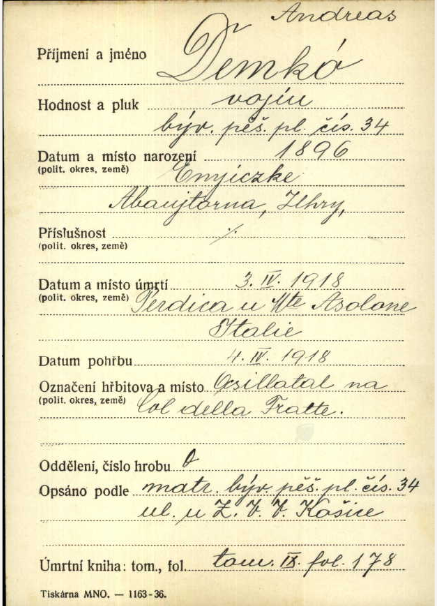
Andrea Demko in Czech Republic, WW1 Fallen Soldiers Cards, 1914-1918, 967
Transcription (Czech/Slovak)
Příjmení a jméno: Demkó Andreas
Hodnost a pluk: vojín, býv. pěš. pl. čís. 34
Datum a místo narození (polit., okres, země): 1896, Čemjáké, Mariapócs, Uhry
Příslušnost: ?
Datum a místo úmrtí (polit., okres, země): 3. VI. 1918, Redicon u St. Bologne, Itálie
Datum pohřbu: 4. VI. 1918
Označení hřbitova a místo: Ossliatale na Col della Fratte
Oddělení, číslo hrobu: 8
Opsáno podle: matr. býv. pěš. pl. čís. 34, ul. u K. K. V. Košice
Úmrtní kniha: tom, fol.: tomu B, fol. 173
Translation (English)
Surname and Name: Demkó Andreas
Rank and Regiment: Private, former Infantry Regiment No. 34
Date and Place of Birth (district, region, country): 1896, Čemjáké (likely modern Čemerné or Čemernianska), Mariapócs, Hungary
Affiliation/Nationality: ?
Date and Place of Death (district, region, country): June 3, 1918, Redicon near St. Bologna, Italy
Date of Burial: June 4, 1918
Grave Location and Place: Ossliatale on Col della Fratte
Section, Grave Number: 8
Copied from: Registry of former Infantry Regiment No. 34, maintained at K. K. V. (Imperial-Royal Command) Košice
Death Register: Volume, Page: Volume B, page 173
Extrapolated Service Biography of Andreas Demkó
Name: Andreas Demkó
Born: 1896, in the village of Čemjáké (possibly modern Čemerné) near Mariapócs, then in the Kingdom of Hungary (Austria-Hungary)
Military Unit: Infanterieregiment Nr. 34 (34th Infantry Regiment), Austro-Hungarian Army
Rank: Vojín (Private)
Military Context & Likely Path
The 34th Infantry Regiment was part of the Austro-Hungarian Army and historically recruited heavily from Eastern Slovakia and northeastern Hungary, including regions near Mariapócs and Košice. During World War I, the regiment saw action on both the Eastern Front (against Russia) and, later in the war, on the Italian Front (against Italy).
Given his age (22 at time of death) and the date of his burial (4 June 1918) near Bologna, Italy, it is highly likely that:
- He was conscripted between 1914–1916, likely trained near Košice or Miskolc, and initially served on the Eastern Front.
- After Russia exited the war in late 1917 (following the Bolshevik Revolution and the Treaty of Brest-Litovsk), many Austro-Hungarian units were redeployed to the Italian Front, where heavy fighting resumed in 1917–1918.
- In May–June 1918, his unit was likely engaged in the Battle of the Piave River, part of a broader Italian campaign.
- He died near Redicon, close to Bologna, likely while the Austro-Hungarian forces were preparing for or engaging in operations along the Col della Fratte, a mountainous area involved in trench warfare and artillery duels.
Circumstances of Death
The burial in an ossuary or cemetery on Col della Fratte suggests:
- He likely died in combat or from wounds sustained in artillery or trench fighting in mountainous terrain.
- The burial date—just one day after his death—suggests field burial near active combat zones, a common practice when holding front lines.
Conclusion
Andreas Demkó was a young conscript from Eastern Hungary who served as a front-line infantryman in one of the Empire’s most battle-hardened regiments. He likely saw harsh conditions on the Eastern Front, was transferred to the brutal Alpine warfare of the Italian Front, and died in the final months of a collapsing empire—far from home, in the mountains of northern Italy, part of a doomed final push to break the stalemate against Italy.
Gregor Demko (1889 or 1890-1915)
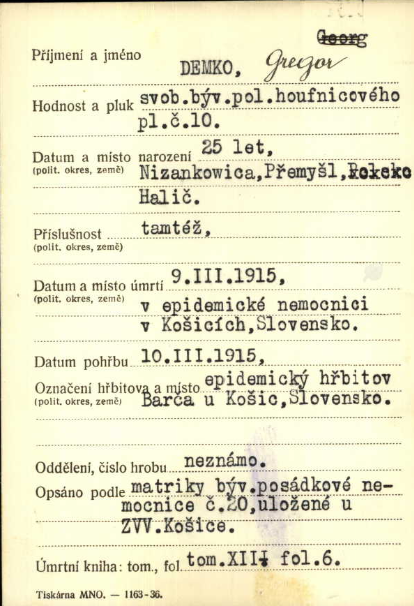
Gregor Demko in Czech Republic, WW1 Fallen Soldiers Cards, 1914-1918, 968
Transcription (Czech/Slovak)
Příjmení a jméno: DEMKO, Gregor
Hodnost a pluk: svob. býv. pol. houfnicového pl. č. 10
Datum a místo narození (polit., okres, země): 25 let, Nizankowice, Przemyśl, Rokoko, Halič
Příslušnost: tamtéž
Datum a místo úmrtí (polit., okres, země): 9. III. 1915, v epidemické nemocnici v Košicích, Slovensko
Datum pohřbu: 10. III. 1915
Označení hřbitova a místo: epidemický hřbitov Barca u Košic, Slovensko
Oddělení, číslo hrobu: neznámo
Opsáno podle: matriky býv. posádkové nemocnice č. 20, uložené u ZVV-Košice
Úmrtní kniha: tom, fol.: tom XII, fol. 6
Translation (English)
Name: DEMKO, Gregor
Rank and Unit: Corporal, former Field Howitzer Regiment No. 10
Date and Place of Birth (district, region, country): Age 25, Nizankowice, Przemyśl, Galicia (Rokoko may be a clerical note or error)
Nationality: Same as above
Date and Place of Death (district, region, country): March 9, 1915, in the epidemic hospital in Košice, Slovakia
Date of Burial: March 10, 1915
Cemetery and Place: Epidemic cemetery in Barca near Košice, Slovakia
Grave section and number: Unknown
Copied from: Registry of former garrison hospital No. 20, held at ZVV-Košice
Death Registry: Volume, Page: Volume XII, page 6
Extrapolated Service Biography of Gregor Demko
Name: Gregor Demko
Born: Circa 1890, in Nizankowice, near Przemyśl in Galicia, then part of the Austro-Hungarian Empire
Military Unit: Feldhaubitzenregiment Nr. 10 (10th Field Howitzer Regiment), Austro-Hungarian Army
Rank: Svobodník (Corporal)
Military Context & Likely Path
The 10th Field Howitzer Regiment was an artillery unit within the Austro-Hungarian Army, likely composed of men from Galicia, Carpathian Ruthenia, and eastern Slovakia. It would have provided indirect fire support—primarily via short-barrelled howitzers—to infantry units on the Eastern Front, especially during the early years of the war.
Given his age (25) and his death in March 1915 in Košice, Slovakia, it is highly likely that:
- He was conscripted or mobilized in 1914, when war broke out between Austria-Hungary and Russia.
- He was part of the Galician campaign—the brutal series of engagements in southeastern Poland and western Ukraine where the Austro-Hungarian Army suffered devastating losses in 1914–15.
- By early 1915, he was either stationed in or evacuated to Košice, a major Austro-Hungarian military medical hub, likely due to injury or exposure to disease.
- The mention of the epidemic hospital suggests he succumbed to infectious disease, such as typhus, cholera, or dysentery—widespread among troops during the winter campaigns.
Circumstances of Death
Gregor died on March 9, 1915, in the epidemic hospital of Košice, and was buried the next day in the epidemic cemetery in Barca, a suburb of the city.
This strongly indicates:
- His death was not combat-related but due to illness, most likely contracted either on the Eastern Front or during transit.
- The anonymous burial (grave number “unknown”) reflects the urgency and scale of epidemic casualties, where mass or rapid burials were common to prevent spread.
- His case is emblematic of a less visible but equally devastating front in the war: the war against disease, fought in overrun hospitals and unsanitary trenches.
Conclusion
Gregor Demko was a Galician artillery corporal whose war was likely spent amid mud, cold, and exhaustion on the Eastern Front. He survived the front lines but succumbed to disease during a critical phase of the Austro-Hungarian campaign against Russia. Far from the battlefield but still a casualty of war, he died in a military hospital in Košice and was buried with countless others who perished not from bullets, but from the invisible contagions that ravaged armies behind the lines.
Ján Demko (1889-1915)
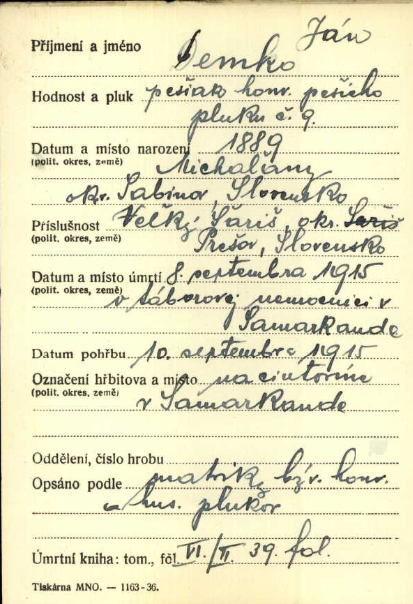
Ján Demko in Czech Republic, WW1 Fallen Soldiers Cards, 1914-1918, 969
Transcription (Czech/Slovak)
Příjmení a jméno: Demko Ján
Hodnost a pluk: pěšák honv. pěšího pluku č. 9
Datum a místo narození (polit., okres, země): 1889, Michalany, okr. Sobrance, Slovensko
Příslušnost (polit., okres, země): Felix Ján, okr. Sobrance, Trebišov, Slovensko
Datum a místo úmrtí (polit., okres, země): 8. září 1915, lobarová pneumonie v Samarkande
Datum pohřbu: 10. září 1915
Označení hřbitova a místo: na civilním hřbitově v Samarkande
Oddělení, číslo hrobu: –
Opsáno podle: matriky býv. honv. pěš. pluku č. 9
Úmrtní kniha: tom, fol.: VI. pt. 39 fol.
Translation (English)
Name: Ján Demko
Rank and Unit: Infantryman, Royal Hungarian Infantry Regiment No. 9
Date and Place of Birth (district, region, country): 1889, Michalany, district of Sobrance, Slovakia
Nationality: Felix Ján, district of Sobrance, Trebišov, Slovakia (note: likely a clerical or household name form)
Date and Place of Death (district, region, country): September 8, 1915, of lobar pneumonia in Samarkand
Date of Burial: September 10, 1915
Grave and Cemetery Location: Civil cemetery in Samarkand
Grave Section and Number: [Not specified]
Recorded from: Registry of former Royal Hungarian Infantry Regiment No. 9
Death Register: Volume, Page: Volume VI, page 39
Contextual Analysis
- Samarkand is located in present-day Uzbekistan, then part of the Russian Empire. This means Ján Demko died in captivity as a Prisoner of War (POW).
- His cause of death was lobar pneumonia, a common and often fatal illness in WWI POW camps due to overcrowding, poor nutrition, and inadequate medical care.
- The Royal Hungarian Infantry Regiment No. 9 (Honvéd IR 9) likely served on the Eastern Front, where many Austro-Hungarian troops were captured by the Russians in Galicia and the Carpathians during 1914–15.
Extrapolated Service Biography of Ján Demko
Name: Ján Demko
Born: 1889 in Michalany, district of Sobrance, in eastern Slovakia (then part of Austria-Hungary)
Military Unit: Magyar Királyi Honvéd Gyalogezred 9 (Royal Hungarian Infantry Regiment No. 9)
Rank: Pěšák (Private Infantryman)
Military Context & Likely Path
The Royal Hungarian Infantry Regiment No. 9 recruited heavily from eastern Slovakia and northeastern Hungary. In 1914–1915, the regiment was deployed on the Galician and Carpathian fronts, facing the Imperial Russian Army in one of the most brutal theaters of the early war.
Given the date of death (September 1915) and the location (Samarkand, Central Asia), it is almost certain that:
- He was captured in battle, likely in late 1914 or early 1915, during one of the Austro-Hungarian defeats in Galicia.
- He was deported across Russia as a POW—part of the mass transfers to Siberia and Central Asia intended to prevent escape and reduce pressure on the front.
- He died of pneumonia in a Russian POW camp in Samarkand, far from the battlefield and his homeland.
Circumstances of Death
- Lobar pneumonia was a leading cause of death in Russian POW camps, especially during winter or overcrowding.
- His burial in a civil cemetery suggests he may have died in a Russian medical facility or quarantine camp and was not interred in a formal military cemetery.
- The delay of two days between death and burial is notable, as it indicates some level of care or bureaucracy in processing POW remains.
Conclusion
Ján Demko was a Slovak infantryman in the Royal Hungarian Army who fought on the Eastern Front and became a prisoner of war. Deported deep into Russian territory, he died in Samarkand of pneumonia—an anonymous casualty of a war that reached across continents. Though far from home, his life and death echo the often-forgotten suffering of Austro-Hungarian POWs lost in the vastness of the Russian Empire.
Ján Demko (II) 1896-1916
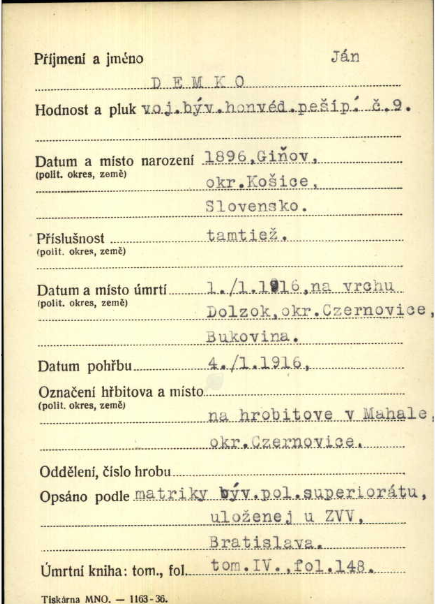
Ján Demko in Czech Republic, WW1 Fallen Soldiers Cards, 1914-1918, 970
Transcription (Czech/Slovak)
Příjmení a jméno: DEMKO Ján
Hodnost a pluk: voj. 1. býv. honvéd. pěš. pl. č. 9
Datum a místo narození (polit., okres, země): 1896, Ďiňová, okr. Košice, Slovensko
Příslušnost: tamtéž
Datum a místo úmrtí (polit., okres, země): 1. I. 1916, na vrchu Dolzok, okr. Czernovice, Bukovina
Datum pohřbu: 4. I. 1916
Označení hřbitova a místo: na hřbitově v Mahale, okr. Czernovice
Oddělení, číslo hrobu: —
Opsáno podle: matriky býv. pol. superiorátu, uložené u ZVV Bratislava
Úmrtní kniha: tom, fol.: tom IV, fol. 148
Translation (English)
Name: Ján Demko
Rank and Regiment: Soldier 1st Class, former Royal Hungarian Infantry Regiment No. 9
Date and Place of Birth (district, region, country): 1896, Ďiňová (likely Ďurkov or a variant; near Košice), Slovakia
Nationality: Same as above
Date and Place of Death (district, region, country): January 1, 1916, on Mount Dolzok, district of Czernowitz, Bukovina
Date of Burial: January 4, 1916
Cemetery and Place: Cemetery in Mahala, district of Czernowitz (present-day Ukraine)
Grave Section and Number: [Not specified]
Copied from: Registry of the former military chaplaincy, held at ZVV (Military Historical Archives) in Bratislava
Death Register: Volume, Page: Volume IV, page 148
Extrapolated Service Biography of Ján Demko (b. 1896)
Name: Ján Demko
Born: 1896 in Ďiňová, near Košice, Slovakia (then part of Austria-Hungary)
Military Unit: Royal Hungarian Infantry Regiment No. 9 (Honvéd Gyalogezred 9)
Rank: Soldier 1st Class (vojín 1. třídy)
Military Context & Likely Path
This Ján Demko served in the same regiment as the previous entry (Honvéd Infantry Regiment No. 9), indicating that the Košice region was a primary recruitment source.
By early 1916, the Austro-Hungarian 9th Infantry Regiment was engaged in mountain warfare in Bukovina (modern-day western Ukraine and northeastern Romania), part of the Eastern Front during heavy fighting between Austro-Hungarian and Russian forces.
Given the location (Mount Dolzok) and date of death (January 1, 1916), it is likely that:
- He was deployed directly to the Carpathian Mountains, in one of the harshest winter campaigns of the war.
- He died during combat or exposure in the Carpathian-Bukovinian sector, which saw heavy losses due to cold, avalanches, disease, and Russian fire.
- His unit was part of the struggle for control of strategic mountain passes near Czernowitz, a fiercely contested city.
Circumstances of Death
- He died on Mount Dolzok, likely either in combat or from extreme exposure.
- He was buried three days later in the nearby town of Mahala, suggesting temporary control by Austro-Hungarian forces and organized burial.
- The lack of a grave number may indicate either temporary field burials or poor record-keeping due to frontline conditions.
Conclusion
Ján Demko, born in 1896 near Košice, died as a soldier of the Austro-Hungarian Honvéd in the frozen peaks of Bukovina. At just 19 or 20 years old, he perished amid one of the war’s most grueling and forgotten campaigns—fighting on icy ridges and forested slopes as the Empire battled for control of the Eastern Carpathians. His body lies in Mahala, a small town near Czernowitz, buried far from home after a bitter winter battle few would survive.